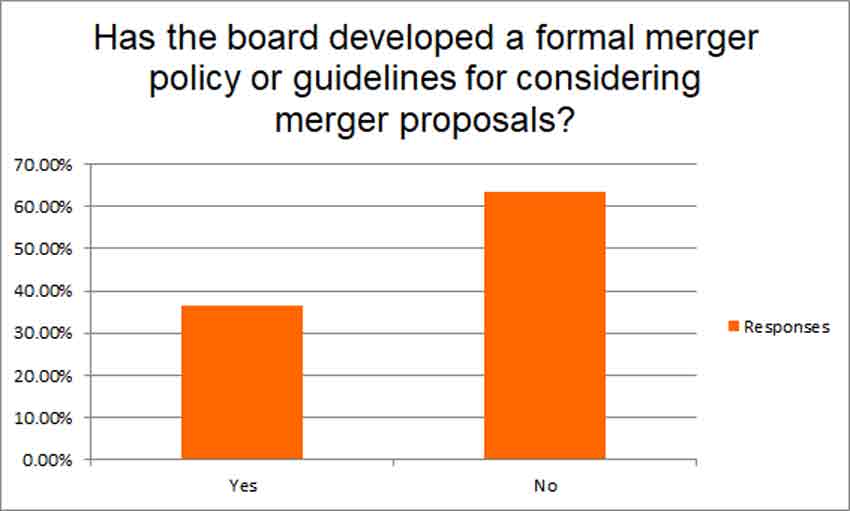
Has your board of directors developed a former merger policy or guidelines for considering a merger?
If you answered "no", you're not alone. According to a study conducted by CEO Advisory Group, an overwhelming majority of boards do not have a formal set of policies and procedures in place when it comes to mergers.
In fact, nearly two-thirds of respondents (63.6%) indicated their boards do not have formal merger policies or guidelines in place, while barely more than one-third indicated they do have at least some form of policy on the books.
A merger policy is a framework by which potential mergers should be evaluated. It should encompass elements such as strategic planning, succession planning, and financial goals. This document should be reviewed regularly (at least annually) and adjusted for any changes in the market or company culture, such that it's up to date, should a merger partner approach your organization.
The merger policy's job is to lay out a framework and address questions that will help you identify when a potential suitor could be the right match for a future merger. It will lay out elements such as:
While it's true that these are difficult conversations to have, the conversations that can happen when you're unprepared can be far worse. You never want to have an offer solicited to you when you don't have a plan in place; that's when mistakes happen, which can leave you on the negative side of an otherwise good deal.
Many leaders think they're doing just fine as they are, and they might be right. However, that doesn't mean there shouldn't be a plan on the books that addresses a potential merger, should the opportunity arise.
Often times, ego and pride can get in the way of leaders making proactive plans that could ultimately benefit their organizations in the long run. Just because a credit union isn't experiencing financial or compliance issues at this very moment in time, it doesn't mean it won't be in trouble at some point in the future. And all problems aside, healthy credit unions that don't have troubles are in the best positions to negotiate with merger partners, so it doesn't make sense to wait until things get bad to put a plan down on paper.
The following are other reasons CEO Advisory Group's study revealed, which may contribute to the fact that many credit unions don't have merger policies in place:
Are you interested in learning about other insights your peers may offer regarding merger policy creation? Download our free white paper to glean insights about the industry at a glance.